
 Uganda
 Ghana
Ghana Liberia
 DRC
DRC Togo
Togo
Why terrestrial resilience is becoming a defining metric of digital infrastructure in Africa?
As AI, cloud platforms and real-time digital services become more embedded in African economies, network resilience is no longer a background technical issue. It is becoming a defining measure of digital infrastructure.
Connectivity now carries more than data. It carries payments, public services, healthcare access, education platforms, enterprise operations and the digital tools that people and businesses increasingly depend on every day.
When the network stops, the impact does not pause. It compounds.
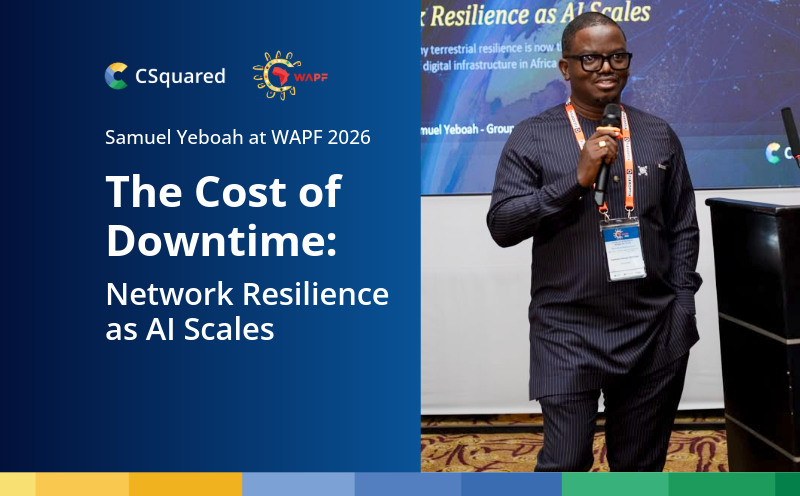
That was the central message of Samuel Yeboah, Group CTO at CSquared, in his presentation at the West Africa Peering Forum 2026: “The Cost of Downtime: Network Resilience as AI Scales.”
Most cable faults go unnoticed. This one didn’t.
West Africa has experienced dozens of subsea cable faults over the past decade. Most were forgotten within weeks. Traffic was rerouted quietly, disruption was contained, and life went on.
But one incident in March 2024 was different.
It was not only important because of what failed. It was important because of what it revealed.
The incident showed that cable diversity on paper does not always mean resilience in practice. Multiple cables may exist, but if they share the same corridor, landing point or failure zone, they may still fail together.
The day West Africa’s cable diversity was tested
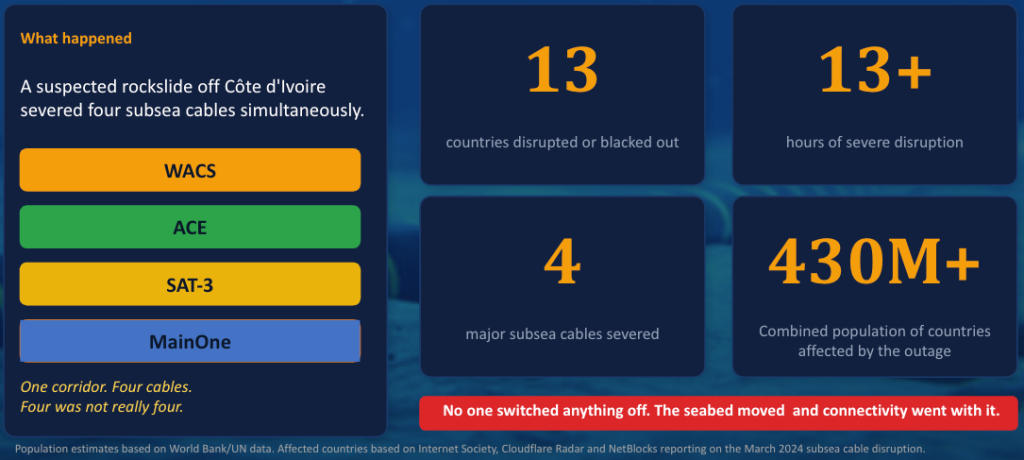
On 14 March 2024, a suspected rockslide off Côte d’Ivoire severed four subsea cables simultaneously:
- WACS
- ACE
- SAT-3
- MainOne
One corridor. Four cables.
Four was not really four.
The disruption affected 13 countries, caused more than 13 hours of severe disruption, and exposed the connectivity dependence of a combined population of more than 430 million people.
No one switched anything off. The seabed moved, and connectivity went with it.
The lesson was clear: resilience cannot be measured only by the number of cables available. It depends on whether those routes are genuinely independent.
AI changes the resilience equation
AI is not only a compute story. It is also a resilience story.
As AI scales, the value carried by every connected minute increases. More of the economy now runs on real-time, cloud-dependent services. Inference sits in a handful of distant regions, and the dependency chain has lengthened.
That changes the consequences of downtime.
Services that once failed gracefully now fail hard because the intelligence is remote. During the March 2024 incident, even unaffected countries lost access to Microsoft Teams and Office 365 until traffic was rerouted. Cloud services failed across borders because routing ran through the affected corridor.
The loss from an outage no longer pauses. It compounds.
AI does not reduce the obligation to keep the path up. It raises the price of every minute it is not.

Panel discussion at WAPF 2026
Every hour offline costs more than money
Network disruption does not only affect connectivity. It can interrupt the digital systems people, businesses and institutions rely on every day.
When the network stops, payments, mobile money, cloud services, healthcare platforms, education systems, trade processes and public services can all be affected.
For SMEs, even a short outage can mean lost sales, missed transactions and reduced customer confidence.
The full cost of downtime is difficult to calculate, but the direction is clear: as more activity becomes digitally enabled, every hour offline carries greater consequences.
Single paths fail. The only questions are when, and what it costs.
Network resilience requires more than capacity. It requires redundancy across multiple dimensions.
The presentation identified three types of failure.
Physical failure
One cable, one duct or one landing station can become a critical point of failure. This was the failure mode the March 2024 incident made visible to the world.
Topological failure
Two routes may appear separate, but still share one chokepoint. This creates diversity on paper, not diversity in practice.
In March 2024, four cables ran through the same corridor off Côte d’Ivoire. Four cables did not mean four independent paths.
Dependency failure
Logical concentration can also create failure. One transit provider, one internet exchange point or one country in the path can become the point of dependency.
Unaffected countries still lost access to cloud services because their routing depended on the affected corridor.
True redundancy means deliberately removing single points of failure across all three dimensions at the same time.
Redundancy is invisible when it works. The job is to make the invisible defensible at board level.
Seven questions every operator should be able to answer
Resilience is not only a technical design principle. It is also a practical risk discipline.
Every operator should be able to answer seven questions:
- Do we have more than one physical path?
- Is our route diversity real or only on paper?
- How dependent are we on another country or landing point?
- Is too much of our international traffic concentrated with one provider?
- Can our network continue operating during a power disruption?
- Do our critical sites have diverse last-mile access?
- Do we have enough capacity headroom for the next disruption?
These questions matter because AI, cloud and video are increasing demand. Today’s spare capacity may disappear quickly during the next disruption.
Resilience by design: open-access wholesale infrastructure
Open-access wholesale infrastructure creates more operators on more diverse paths, reducing single points of failure for everyone on the network.
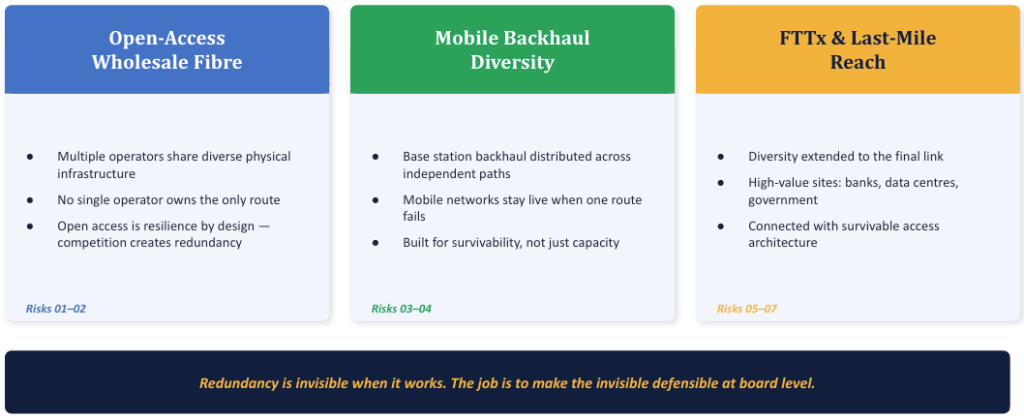
For CSquared, resilience is built across three areas.
Open-access wholesale fibre
Multiple operators can share diverse physical infrastructure. No single operator owns the only route. Open access is resilience by design because competition creates redundancy.
Mobile backhaul diversity
Base station backhaul can be distributed across independent paths. This helps mobile networks stay live when one route fails. The network is built for survivability, not just capacity.
FTTx and last-mile reach
Resilience must extend to the final link. High-value sites such as banks, data centres and government institutions should be connected with survivable access architecture.
The central point is simple: resilience should not be added after failure. It should be designed into the network from the start.
Design for the outcome, not the cause
The presentation ended with one line to take away:
Design for the outcome. Not the cause.
The result is the same whether the threat is a rockslide, an anchor, a power cut or a fault no one saw coming.
As AI scales and digital services become more deeply embedded in economies, resilience becomes more than a network engineering concern. It becomes an economic priority.
The question is not whether failure will happen.
The question is whether the network has been designed to survive it.
CSquared: building resilient digital infrastructure for Africa
CSquared is helping build open-access wholesale infrastructure that supports reliable, scalable and resilient connectivity across Africa.
By enabling more operators to use shared infrastructure, extending diversity across mobile backhaul and improving last-mile reach, CSquared supports the foundations needed for a more connected and resilient digital economy.